
May 2026 President Letter
Aligning How We Tell the U.S. FTZ Story
A program can deliver real value—but if that value isn’t clearly understood, it won’t carry the weight it should.
We’re at that point with the U.S. Foreign-Trade Zone program.
The program continues to support American jobs, strengthen domestic investment, and help companies compete globally. That foundation remains strong. What has changed is the environment around it. There is more attention on trade policy. More scrutiny. More opportunities for misunderstanding. And more competition for mindshare among policymakers, business leaders, and the media.
In that environment, clarity isn’t optional—it’s essential.
How we talk about the U.S. FTZ program now matters just as much as what the program actually does.
And right now, we need to be aligned.
From Complexity to Clarity
One of the consistent challenges across our community is that we know this program too well.
We live in the details—compliance, procedures, and the mechanics of the program. That expertise is critical. But when we bring that same level of complexity into every conversation, we lose the audience we’re trying to reach.
Over the past several months, NAFTZ has been working closely with Violet PR (NAFTZ’s strategic communications and media relations partner) to step back from that complexity and sharpen how we communicate the value of the U.S. FTZ program—whether we’re speaking with a prospective company, a C-suite executive, or a policymaker.
Efficiency. Financial Flexibility. Global Competitiveness.
The E-F-G framework is not a tagline. It’s a tool. It gives all of us a consistent, credible, and easy-to-use way to communicate the core value of the program—without losing accuracy or oversimplifying what makes it work.
A Clear Standard Going Forward
Let me be direct:
We need to be speaking with a more consistent voice as a community.
That means:
- Leading with value—not mechanics
- Communicating in clear, concise terms—not internal jargon
- Framing the program in ways that resonate externally—not just within our own circles
And just as importantly:
We should be consistently referring to the program as the U.S. Foreign-Trade Zone (FTZ) program.
That distinction matters. It reinforces that this is a U.S.-based, federally authorized, highly regulated program—very different from “free zones” or loosely defined international models. Clarity here is not semantics. It’s positioning.
What This Looks Like in Practice
This doesn’t require a complete rewrite of how you communicate. It requires discipline.
When you’re describing the program:
- Start with the outcome:
“The U.S. FTZ program helps companies operate more efficiently, manage costs more effectively, and compete globally.” - Then layer in context as needed—not all at once
- Tailor the emphasis depending on your audience:
- Policymakers → economic impact, jobs, domestic investment
- Executives → cost alignment, cash flow, operational agility
- Prospects → practical pathway and business value
The goal isn’t to say less. It’s to say what matters first—and say it clearly.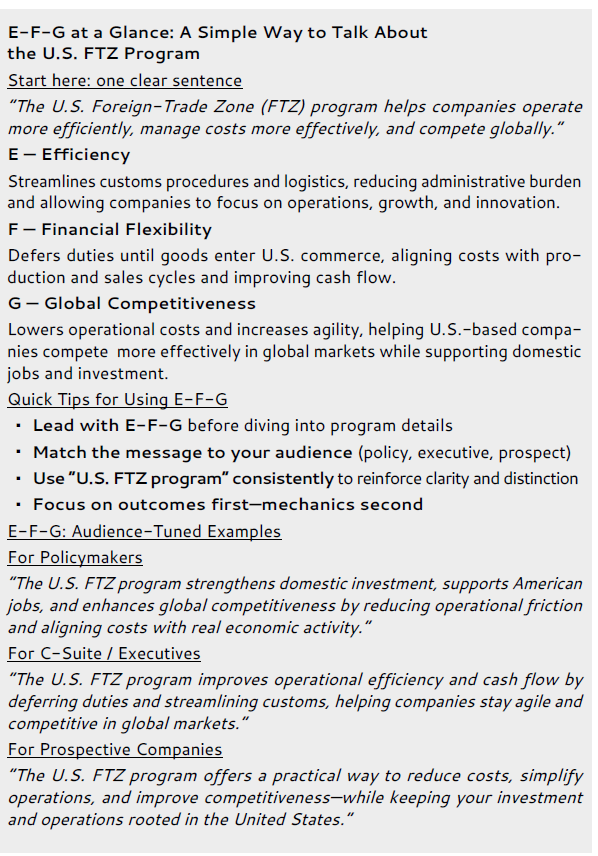
Why This Matters Now
We are operating in a moment where the U.S. FTZ program is increasingly part of broader national conversations—whether around trade policy, supply chains, or domestic manufacturing.If we’re not clear and consistent in how we communicate its value, others will fill in the gaps—and not always accurately. This is one of the most effective, proven tools available to support U.S. economic competitiveness. We should be able to explain that—quickly, clearly, and consistently—every time.
Moving Forward Together
The core takeaway is this:
We have an opportunity—right now—to shape how the U.S. FTZ program is understood for years to come.
When we align how we communicate its value—clearly, consistently, and with confidence—we elevate the entire program. We make it easier for policymakers to understand. We make it more compelling for businesses to engage. And we reinforce its role as a trusted, proven tool supporting American jobs, investment, and global competitiveness.
That kind of alignment doesn’t happen by chance—it happens when we choose to be intentional about it.
The Grantee-focused webinar:
Explaining FTZ Value with Clarity and Confidence: A Practical Messaging Framework for Grantees
User/Operator-Service Provider-3FP:
Explaining FTZ Value with Clarity and Confidence: A Practical Messaging Framework for Internal and External Communication